
The Role of SD-WAN in Modern Business Connectivity
What Is SD-WAN and How Does It Work
SD-WAN (Software-Defined Wide Area Network) is a networking approach that separates the control plane from the physical hardware, allowing IT teams to manage wide area network traffic through software rather than configuring individual devices manually. Think of it as a programmable layer sitting above your physical connections — broadband, LTE, MPLS — that decides in real time how traffic should flow.
At its core, SD-WAN creates a network overlay on top of whatever physical underlay connections you already have. The software monitors link quality continuously and routes traffic across the best available path based on policies you define. A video call gets prioritized over a file backup. A latency-sensitive application gets steered away from a congested link automatically.
Centralized management is what makes this practical at scale. Instead of logging into each router at each branch, network administrators configure policies once and push them across every site from a single dashboard. That shift — from per-device configuration to network orchestration — is what fundamentally changes how IT teams operate.
How SD-WAN Differs from Traditional WAN and MPLS
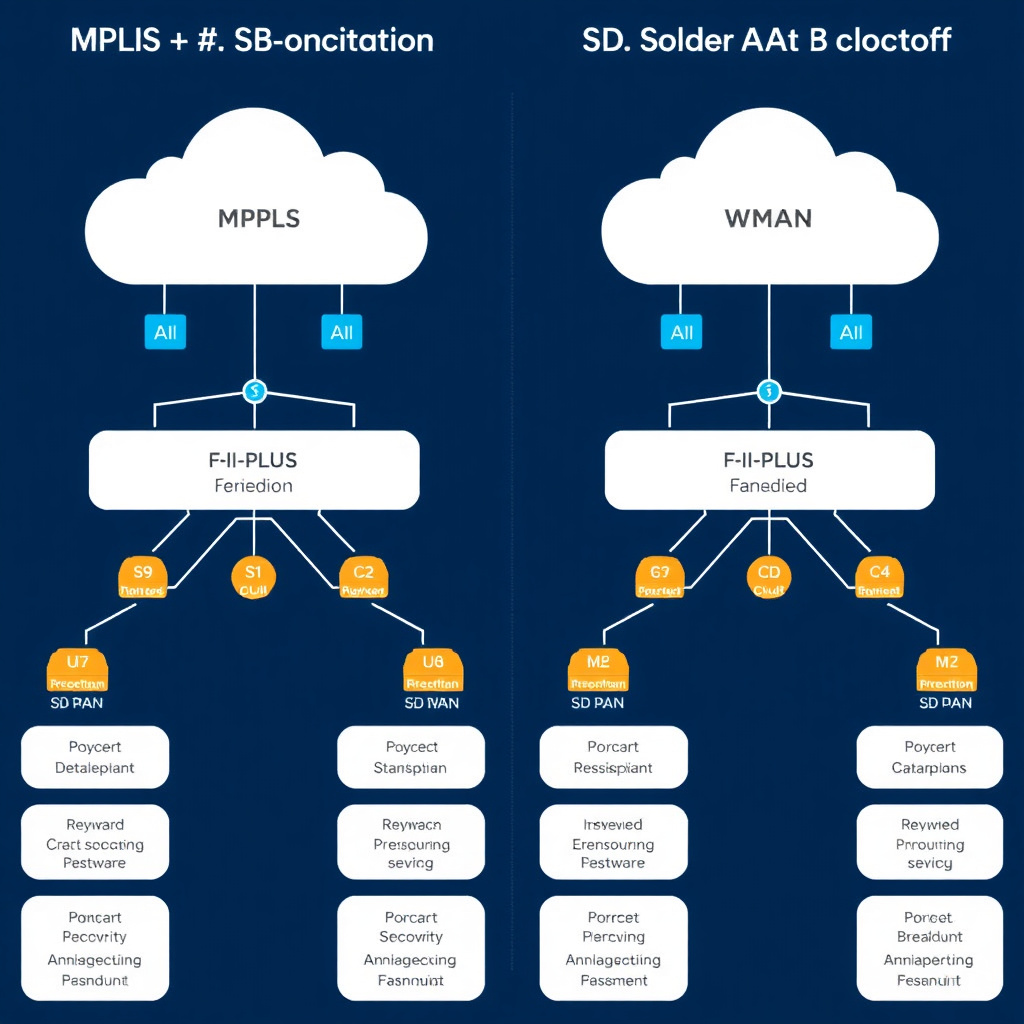
The main difference is cost and flexibility. Traditional WAN architectures built on MPLS (Multiprotocol Label Switching) deliver reliable, predictable performance, but they come with long provisioning timelines, rigid contracts, and per-megabit pricing that becomes painful as bandwidth demands grow.
MPLS was designed for a world where traffic flowed between corporate data centers. It does that job well. But when most of your applications live in the cloud and your workforce is distributed, routing everything back through a central hub before it reaches the internet creates unnecessary latency and bottlenecks.
SD-WAN addresses this by enabling a hybrid WAN model — you can keep MPLS for traffic that genuinely needs it while using cheaper broadband or LTE for everything else. New branch offices can be connected in days rather than weeks. Bandwidth can be added without renegotiating a carrier contract. The trade-off is that broadband links are less deterministic than MPLS, so SD-WAN's dynamic path selection and Quality of Service policies do real work to compensate.
Key Benefits of SD-WAN for Businesses
SD-WAN delivers four concrete advantages that matter to both IT teams and business leadership: performance, visibility, cost reduction, and resilience.
Performance optimization comes from dynamic path selection and QoS policies. Rather than sending all traffic down a single pipe, SD-WAN continuously measures packet loss, latency, and jitter across available links and routes each application accordingly. Real-time applications like VoIP and video conferencing stay responsive even when one link degrades.
Centralized visibility gives network teams a single pane of glass across every site. Troubleshooting a connectivity issue at a remote branch no longer requires dispatching someone on-site or piecing together logs from multiple systems. You can see what's happening, where, and why — from one console.
On the cost side, replacing or supplementing expensive MPLS circuits with commodity broadband typically reduces WAN transport costs by 30–60%, depending on the existing infrastructure. That's a meaningful number for organizations running dozens of branch locations.
Resilience improves because SD-WAN can aggregate multiple links and fail over automatically. If a primary connection drops, traffic shifts to a backup path in seconds rather than waiting for manual intervention or a carrier SLA response.
SD-WAN and Cloud Connectivity
SD-WAN is purpose-built for cloud-first environments, and that's not marketing language — it reflects a genuine architectural alignment. When your critical workloads run on AWS, Azure, Microsoft 365, or Salesforce, the old model of backhauling traffic through a central data center before it reaches the internet adds latency that users feel.
SD-WAN enables direct cloud breakout at the branch level. Traffic destined for cloud-native applications goes directly to the internet from the nearest exit point, bypassing the corporate hub entirely. The result is noticeably better SaaS application performance — particularly for latency-sensitive tools like unified communications platforms.
Most enterprise SD-WAN platforms also include native integrations with major cloud providers, allowing organizations to extend their network fabric directly into virtual private clouds. This makes SD-WAN a foundational component of any serious cloud migration strategy, not just a WAN upgrade.
Security Considerations: SD-WAN and SASE/ZTNA
SD-WAN improves connectivity, but it also expands the attack surface — and that tension deserves honest attention. Distributing internet breakout across dozens of branch locations means each site becomes a potential entry point if security isn't built into the architecture from the start.
This is where SASE (Secure Access Service Edge) enters the picture. SASE converges SD-WAN networking capabilities with cloud-delivered security services — including firewall-as-a-service, secure web gateway, and Zero Trust Network Access (ZTNA) — into a unified framework. Rather than bolting security on after the fact, SASE treats it as inseparable from the network fabric itself.
ZTNA is particularly relevant for hybrid work environments. Instead of granting broad network access once a user authenticates (the traditional VPN model), ZTNA verifies identity and device posture continuously and grants access only to specific applications. Combined with SD-WAN's traffic steering, this creates a network where access is earned per session, not assumed per connection.
Organizations evaluating SD-WAN should treat security architecture as a first-class requirement, not an afterthought. Vendors vary significantly in how deeply security is integrated versus how much it relies on third-party add-ons.
Use Cases: Who Benefits Most from SD-WAN
SD-WAN delivers the clearest value in environments where network complexity, geographic distribution, or cloud dependency creates real operational pain. A few scenarios stand out.
- Multi-branch enterprises — Retail chains, financial services firms, and professional services organizations with 10+ locations gain the most from centralized orchestration and consistent policy enforcement across sites.
- Remote and hybrid workforces — As work-from-anywhere becomes permanent for many organizations, SD-WAN combined with ZTNA provides a more scalable and secure alternative to legacy VPN infrastructure.
- Healthcare networks — Hospitals and clinic networks running latency-sensitive applications like telemedicine, EHR systems, and medical imaging benefit from QoS policies that prioritize critical traffic without requiring dedicated circuits everywhere.
- Cloud-heavy organizations — Any business that has moved the majority of its applications to SaaS or IaaS platforms will see measurable performance improvements from direct cloud breakout and SD-WAN's application-aware routing.
SD-WAN is less compelling for organizations with a single location, minimal cloud usage, or highly stable, low-complexity network requirements. The management overhead and deployment investment only pay off when there's genuine distributed complexity to solve.
What to Consider Before Adopting SD-WAN
Before committing to an SD-WAN deployment, there are several practical factors worth working through carefully — because the technology is mature, but implementations vary widely in quality and fit.
Vendor selection matters more than it might seem. The SD-WAN market includes purpose-built vendors, traditional networking incumbents, and telecom carriers offering managed services. Each has different strengths. Purpose-built vendors often lead on features and flexibility; carriers offer simpler procurement and support; incumbents integrate tightly with existing infrastructure. There's no universally right answer — it depends on your team's capabilities and your existing environment.
The managed vs. DIY question is closely related. Running SD-WAN yourself requires network engineering expertise and ongoing operational investment. Managed SD-WAN services shift that burden to a provider but reduce control and can increase long-term costs. Mid-market organizations without large networking teams often find managed services the more realistic path.
Existing infrastructure compatibility deserves a realistic assessment. SD-WAN doesn't require ripping out everything, but integration with legacy systems, existing security tools, and carrier contracts takes planning. A phased migration — starting with new sites or high-priority locations — is usually more practical than a simultaneous cutover.
Finally, total cost of ownership calculations should include not just hardware and licensing, but implementation services, training, and the operational cost of managing the platform over time. The transport savings are real, but they don't always materialize immediately. For a deeper grounding in how software-defined networking principles underpin SD-WAN, the Wikipedia overview of software-defined networking provides useful context on the broader architectural shift.
Frequently Asked Questions
What is the difference between SD-WAN and MPLS?
MPLS is a dedicated, carrier-managed transport technology known for reliability and predictable performance. SD-WAN is a software layer that can run over MPLS, broadband, LTE, or any combination — and intelligently routes traffic across those links. SD-WAN is more flexible and typically less expensive; MPLS offers stronger guarantees for latency-sensitive traffic. Many organizations use both together in a hybrid WAN model.
Is SD-WAN suitable for small and mid-sized businesses?
It can be, particularly for SMBs with multiple locations or heavy cloud usage. Managed SD-WAN services lower the barrier by handling deployment and operations. That said, a single-site business with straightforward connectivity needs is unlikely to see enough benefit to justify the investment.
How does SD-WAN improve application performance?
SD-WAN monitors link quality in real time and uses QoS policies to route each application over the best available path. Latency-sensitive applications like video conferencing get priority; bulk transfers use whatever capacity is available. Direct cloud breakout also eliminates the latency added by backhauling traffic through a central data center.
Can SD-WAN work alongside existing network infrastructure?
Yes. SD-WAN is designed to overlay existing connections, including MPLS circuits, broadband, and LTE. Most deployments are phased, adding SD-WAN capabilities progressively rather than replacing everything at once. Compatibility with existing security tools and cloud environments varies by vendor and should be evaluated during the selection process.
What is the relationship between SD-WAN and SASE?
SASE (Secure Access Service Edge) is a framework that combines SD-WAN networking with cloud-delivered security services — including ZTNA, secure web gateway, and firewall-as-a-service — into a unified architecture. SD-WAN is the networking foundation; SASE adds the security layer on top. Organizations moving toward SASE typically start with SD-WAN and layer in security capabilities over time.